
Understanding the Corrugated Sheet Production Process
The corrugated sheet production process is the backbone of modern industrial packaging. Behind every corrugated sheet used in logistics, manufacturing, and distribution lies a carefully controlled sequence of steps designed to deliver strength, consistency, and reliability at scale.
Across North America, corrugated sheet manufacturing supports high-volume supply chains that depend on predictable performance and efficient delivery. Understanding how corrugated sheets are produced—from raw material sourcing to final delivery—provides valuable insight into why corrugated packaging remains one of the most trusted materials in the packaging manufacturing industry.
This article explores the complete corrugated sheet production process, highlighting how materials, technology, quality control, and logistics work together to support industrial packaging requirements.
Raw Materials Used in Corrugated Sheet Manufacturing
The corrugated sheet production process begins with carefully selected raw materials. Corrugated sheets are primarily manufactured using paper-based materials, including linerboard and corrugated medium.
Linerboard and Corrugated Medium
- Linerboard forms the flat outer layers of the corrugated sheet, providing surface strength and protection.
- Corrugated medium is the fluted paper layer that creates the sheet’s structural strength and cushioning properties.
These materials are sourced from renewable fibers and recycled paper streams, supporting sustainability while delivering the performance required for industrial packaging applications.
Raw material consistency is essential. Variations in fiber quality, moisture content, or paper strength can directly impact the final corrugated sheet’s performance.
Paper Preparation and Conditioning
Before corrugation begins, raw paper materials undergo preparation and conditioning to ensure they meet production requirements. This stage plays a critical role in achieving uniform quality throughout the corrugated sheet production process.
Key preparation steps include:
- Moisture control to maintain paper flexibility
- Temperature conditioning for consistent forming
- Tension regulation to prevent tearing or distortion
Proper conditioning ensures that linerboard and medium perform predictably during high-speed production, reducing waste and improving overall efficiency.
The Corrugating Process: Forming the Flutes
The core of the corrugated manufacturing process occurs at the corrugator. During this stage, the corrugated medium is passed through heated corrugating rolls that shape it into precise flutes.
Once formed, the fluted medium is bonded to linerboard using a starch-based adhesive, creating a single wall corrugated sheet. For applications requiring additional strength, a second linerboard layer is added to form double wall structures.
Modern corrugators are capable of producing multiple flute profiles, including:
- B flute
- C flute
- E flute
- F flute
- T flute
- Micro-flute configurations
Each flute type offers specific performance characteristics related to strength, thickness, and cushioning.
Sheet Formation and Cutting
After bonding, corrugated sheets move through the production line for trimming and cutting. At this stage, sheets are cut to precise dimensions based on customer requirements and downstream converting processes.
Advanced cutting systems ensure:
- Accurate sheet dimensions
- Clean edges for efficient converting
- Consistency across large production volumes
Precision at this stage is essential, as dimensional accuracy directly impacts converting efficiency and packaging performance.
Quality Control Throughout Production
Quality control is integrated into every stage of the corrugated sheet production process. Industrial packaging customers rely on consistent sheet performance to support automated converting, printing, and assembly operations.
Quality control measures include:
- Continuous monitoring of flute geometry and board thickness
- Adhesion testing between linerboard and medium
- Strength and performance verification
- Visual inspection for defects
Modern corrugated manufacturing facilities use real-time monitoring and data-driven controls to maintain consistent output and reduce variability between production runs.
Waste Reduction and Material Optimization
Efficiency and sustainability are closely linked within corrugated sheet manufacturing. Waste reduction and material optimization are key priorities throughout the production process.
Manufacturers focus on:
- Reducing trim waste
- Optimizing material usage
- Recycling production by-products
- Improving process efficiency
These practices help lower environmental impact while maintaining the performance standards required for industrial packaging.
Packaging and Palletization of Corrugated Sheets
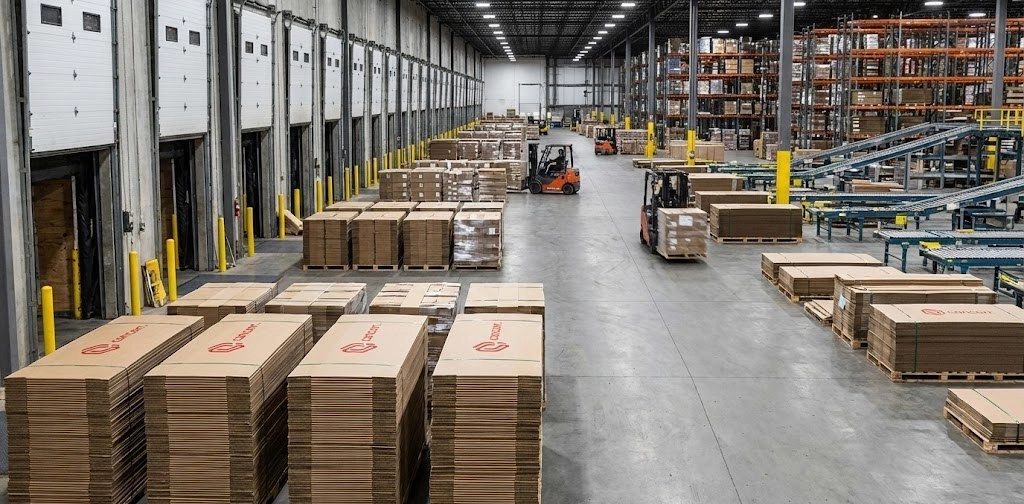
Once produced and inspected, corrugated sheets are prepared for shipment. This stage involves organizing sheets into stacks, securing loads, and preparing them for transport.
Proper packaging and palletization:
- Protect sheets during handling and transport
- Maintain sheet alignment and quality
- Improve loading efficiency
In some operations, pallet-less delivery systems are used to further reduce material usage and handling waste.
Logistics and Delivery of Corrugated Sheets
Logistics is a critical component of the corrugated sheet production process. High-capacity manufacturing must be supported by reliable distribution systems to ensure timely delivery.
Modern corrugated sheet logistics focus on:
- Just-in-time delivery models
- Route optimization
- Real-time shipment tracking
- Reduced transportation waste
Satellite-tracked fleets and intelligent scheduling systems help ensure corrugated sheets arrive on time and in optimal condition.
Supporting Industrial Supply Chains Across North America
The corrugated sheet production process is designed to support complex industrial supply chains across North America. From manufacturing hubs to distribution centers, corrugated sheets enable efficient packaging, storage, and transport.
Reliable corrugated sheet manufacturing supports:
- Consistent packaging supply
- Reduced downtime for converters
- Predictable production planning
- Efficient logistics operations
This reliability is essential for industries operating at scale, where packaging availability directly impacts operational continuity.
The Importance of Process Integration
Modern corrugated sheet manufacturing relies on integrated systems that connect production, quality control, and logistics. This integration enables manufacturers to respond quickly to changes in demand while maintaining consistent performance.
Integrated production systems support:
- Faster response times
- Improved coordination between departments
- Enhanced visibility across the supply chain
- Continuous improvement initiatives
Process integration is a defining characteristic of advanced corrugated manufacturing operations.
The Future of Corrugated Sheet Production
As packaging requirements evolve, the corrugated sheet production process will continue to advance. Future developments are expected to emphasize:
- Increased automation
- Greater data-driven process control
- Enhanced sustainability practices
- Improved supply chain integration
These advancements will further strengthen corrugated packaging’s role in supporting modern industrial supply chains.
Conclusion: From Raw Material to Reliable Delivery
The corrugated sheet production process is a carefully engineered sequence that transforms raw paper materials into reliable industrial packaging solutions. Through precise manufacturing, rigorous quality control, and efficient logistics, corrugated sheet manufacturing supports some of the most demanding supply chains across North America.
By understanding each stage—from raw material sourcing to final delivery—it becomes clear why corrugated sheets remain a foundational element of the packaging manufacturing industry. As technology and sustainability expectations continue to evolve, corrugated sheet production will remain essential to delivering efficient, consistent, and future-ready packaging solutions.